From Data Blindness to Operational Intelligence
How one intelligence layer surfaced $320K in recoverable OTC margin, a 97.7% distributor concentration risk, and $21K in dead stock — in a single analysis of 13 months of existing data.
The Challenge
The Invisible Cost of Data You Cannot Read
A 7-store pharmacy group was operating with unseen margin leakage, unquantified supplier risk, and $21K in capital tied up in dead stock. The data existed in their pharmacy management system. They just had no way to read it at the speed and depth needed to act.
Without an intelligence layer, the group had zero visibility into which OTC departments were underperforming on margin, which distributor represented a concentration risk to an entire department, or which manufacturers offered rebate leverage they were already earning but not capturing.
The answers were in the data the whole time. They just were not visible.
THREE THINGS THE GROUP COULD NOT SEE
OTC margin gaps,invisible
11,470 SKUs priced below department average. No system flagged it. No one knew.
Distributor concentration, undetected
One distributor held 97.7% of Cough and Cold revenue. The group had no visibility into the exposure.
Dead stock tying up capital
50 SKUs with 5+ units on hand and zero sales. Capital locked with no flag and no action.
All three found in the first analysis. None were visible before the intelligence layer connected.
BEFORE
6 pharmacy assistants
Manual stock ordering. Back office. Every store, every day.
7 separate ordering cycles
No shared view. No group intelligence. Each store siloed.
160+ hours per week
Spent on tasks the intelligence layer now handles in seconds.
AFTER
6 assistants at the front counter
Back with patients. Where skilled care actually belongs.
1 role managing all 7 stores
Group-wide intelligence from a single connected layer.
160+ hours reclaimed weekly
Ordering decisions automated. Manual cycles eliminated.
The Transformation
The Talent Reallocation
Modernisation is not about cutting headcount. It is about Resource Reallocation.
By centralising the intelligence layer, we moved 6 skilled assistants back to the front counters where they could focus on patient care instead of managing stock.
"Our team is now where they belong with our patients."
Operations Director
The Solution
What the Intelligence Layer Found
LensPharm connected to the group's existing pharmacy management system and ingested 13 months of transactional data. No new systems. No new staff. The intelligence was already in the data.
Distributor Concentration Risk
One distributor controlled 97.7% of Cough and Cold department revenue. $676K annual exposure through a single supply relationship. The group did not know this risk existed until the first analysis surfaced it.
OTC Repricing Opportunity
$320K in recoverable margin identified across 11,470 OTC SKUs priced below their department average. Every product is within owner-controlled pricing. No PBS constraints. Actionable from day one.
Manufacturer Intelligence Layer
Viatris and Arrotex alone generate $3.14M of dispensary revenue across 3,744 SKUs. Haleon, Kenvue, and Reckitt Benckiser deliver 6 to 7 percentage points below dispensary margin. Group-level volume creates rebate leverage no individual store can access.
HOW THE INTELLIGENCE LAYER WORKS
Connect to existing PMS
No new systems. No migration. The connector reads directly from the pharmacy management system the group already runs. 13 months of transactional data ingested.
Normalise across all 7 stores
Data from each store is mapped to a canonical schema. Departments, suppliers, manufacturers, and SKUs become comparable across the group for the first time.
Run validated Insight categories
Each insight category runs a governed SQL query against the connected data. Every number is verified. Every answer includes its source, its row count, and its trace ID.
Surface verified findings
Plain English narration delivered with every insight. No interpretation required. No analyst needed.
WHAT THIS ANALYSIS FOUND
Distributor Concentration Risk
97.7% of Cough and Cold through one distributor. $676K at risk.
OTC Repricing Opportunity
$320K recoverable margin across 11,470 OTC SKUs.
Manufacturer Rebate Leverage
$3.14M revenue across Viatris and Arrotex. Group-level leverage unlocked.
Strategic Outcome
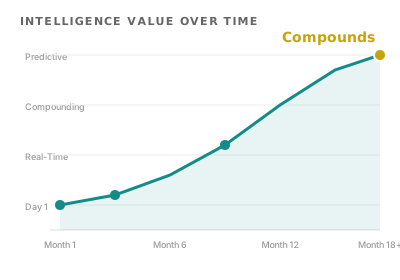
Intelligence Compounds.
This analysis covers 13 months of historical data. The platform has not yet been running in real time. What you see here is the concentration risk, the margin gaps, the dead stock was invisible the day before the first analysis ran.
Identified in OTC categories across 11,470 SKUs. Dispensary excluded, PBS pricing applies. This is what 13 months of static data finds. Continuous intelligence finds more, faster.
The platform does not reset. It accumulates. Month 14 onwards, it knows the group's seasonal patterns, manufacturer relationships, and margin gaps in real time. The intelligence compounds with every query.
What This Unlocks
The platform is vertical-agnostic. The National Pharmacy Group case study is the proof.
LensPharm is the first vertical deployment of the Squadera operational intelligence platform. The same architecture, same governance layer, same traceability, same compounding memory maps to any business running on serious operational data.
13 months of data found $320K in OTC repricing opportunity, a critical distributor concentration risk, and $3.14M in manufacturer rebate leverage. Continuous real-time intelligence compounds this further. The platform does not reset. It accumulates.
Stop Managing Boxes. Start Managing Performance.
Find out where your execution is breaking down.
START THE DECISION READINESS CHECK →